
The "Cover My Costs" Trap: Why Overpricing Your Home to Pay Your Debts Always Backfires
As a homeowner, it is only natural to look at your property through the lens of your own financial needs. When it’s time to sell, you sit down with a calculator and start adding up the numbers: the remaining mortgage balance, that HELOC you took out for the kitchen remodel, the standard 6% real estate commission, and the closing costs. You arrive at a "magic number"—the amount you need to walk away clean.
But here is the hard truth of real estate: The market does not care what you owe.
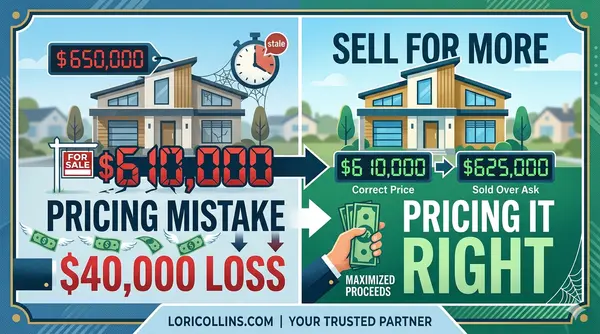
At LoriCollins.com, I see this dilemma often. Sellers frequently want to price their home based on their financial obligations rather than the home’s actual market value. This strategy—pricing a home above its After Repair Value (ARV) or current market comps just to "cover the costs"—is one of the most dangerous mistakes a seller can make.
The Appraisal Gap and the "Invisible Wall"
When you overprice a home, you aren’t just "testing the market." You are hitting an invisible wall.
Even if you find a buyer who falls in love with the home and agrees to your inflated price, the transaction rarely makes it to the closing table. Why? Because of the appraisal. Unless your buyer is paying 100% cash, their lender will require an appraisal. Appraisers look at "hard data"—closed sales of similar homes within a tight radius over the last six months.
If your home is listed at $500,000 but the market value is $450,000, the bank will only loan based on the $450,000 figure. The deal will likely collapse unless you drop the price or the buyer brings an extra $50,000 in cash to the table (which is rare).
The Stigma of "Days on Market"
In real estate, time is money. A home gets the most attention in its first 14 days on the market. That is when the "New Listing" alerts hit buyers' phones and excitement is high.
When a home is overpriced, savvy buyers and their agents see it immediately. They don’t even book a showing; they simply wait. As the days on market (DOM) climb to 30, 60, or 90 days, the property develops a stigma. Buyers start asking, "What’s wrong with it?" Eventually, to get any movement, you’re forced to make price cuts. Ironically, homes that sit on the market usually end up selling for less than they would have if they had been priced correctly from day one.
A Real-World Example: The Math of a Misstep
Let’s look at a hypothetical scenario to see how this plays out in the real world.
The Property: A 3-bedroom ranch in a neighborhood where the highest-ever sale (the ARV) for a fully renovated home is $400,000. This specific home needs a new roof and has dated 1990s interiors. Its actual market value is $365,000.
The Seller’s Math:
-
Mortgage Payoff: $350,000
-
Back Taxes/Lien: $15,000
-
Real Estate Commissions (6%): $25,200
-
Closing Costs (2%): $8,400
-
Total Needed to Break Even: $398,600
The seller insists on listing at $420,000 to leave "negotiating room" and ensure their debts are paid.
The Result:
-
Weeks 1-4: Zero offers. Several agents provide feedback that the home is "grossly overpriced" compared to renovated homes in the area.
-
Month 2: The seller drops the price to $405,000. Still no bites because the home still needs $25,000 in repairs to even reach that value.
-
Month 4: Desperate, the seller drops to $375,000. By now, buyers wonder if the house has foundation issues or mold. An investor finally swoops in with a "lowball" offer of $350,000.
-
The Outcome: The seller, exhausted and facing a mounting mortgage, accepts. They end up having to bring cash to the closing table anyway—or worse, facing a short sale—after wasting four months of mortgage payments and utility bills.
The Inflated ARV Delusion
The "After Repair Value" (ARV) is a term often used by investors to describe what a home will be worth after it is perfect. Sellers often see a neighbor's house sell for a record-breaking price and assume their home is worth the same, ignoring the fact that the neighbor had a brand-new roof, professional landscaping, and a designer kitchen.
If your home’s "break-even" price is higher than the ARV of the neighborhood, you aren’t selling a house; you’re asking a buyer to pay for your lack of equity.
The Bottom Line
Pricing your home to cover your liens, commissions, and costs is a strategy based on emotion and necessity, not economics. Buyers don't buy based on your needs; they buy based on value compared to the house down the street.
If you are concerned that your home’s value won’t cover your costs, it is time for a transparent conversation. At LoriCollins.com, I specialize in helping sellers navigate difficult equity situations with honest data and strategic marketing. Sometimes the answer is a short sale, sometimes it’s making strategic mini-improvements to boost value, and sometimes it’s waiting for the market to catch up.
Don't let your "break-even" number break your sale. Let’s look at the real data and get your home sold the right way.
Categories
Recent Posts